
Records are copied between tools and drift out of sync.
API development & business integrations
Operithm builds API integrations and data workflows between CRMs, ERP systems, online stores, payments, accounting, and operational tools. Validation, duplicate handling, monitoring, and recovery are part of the connection.
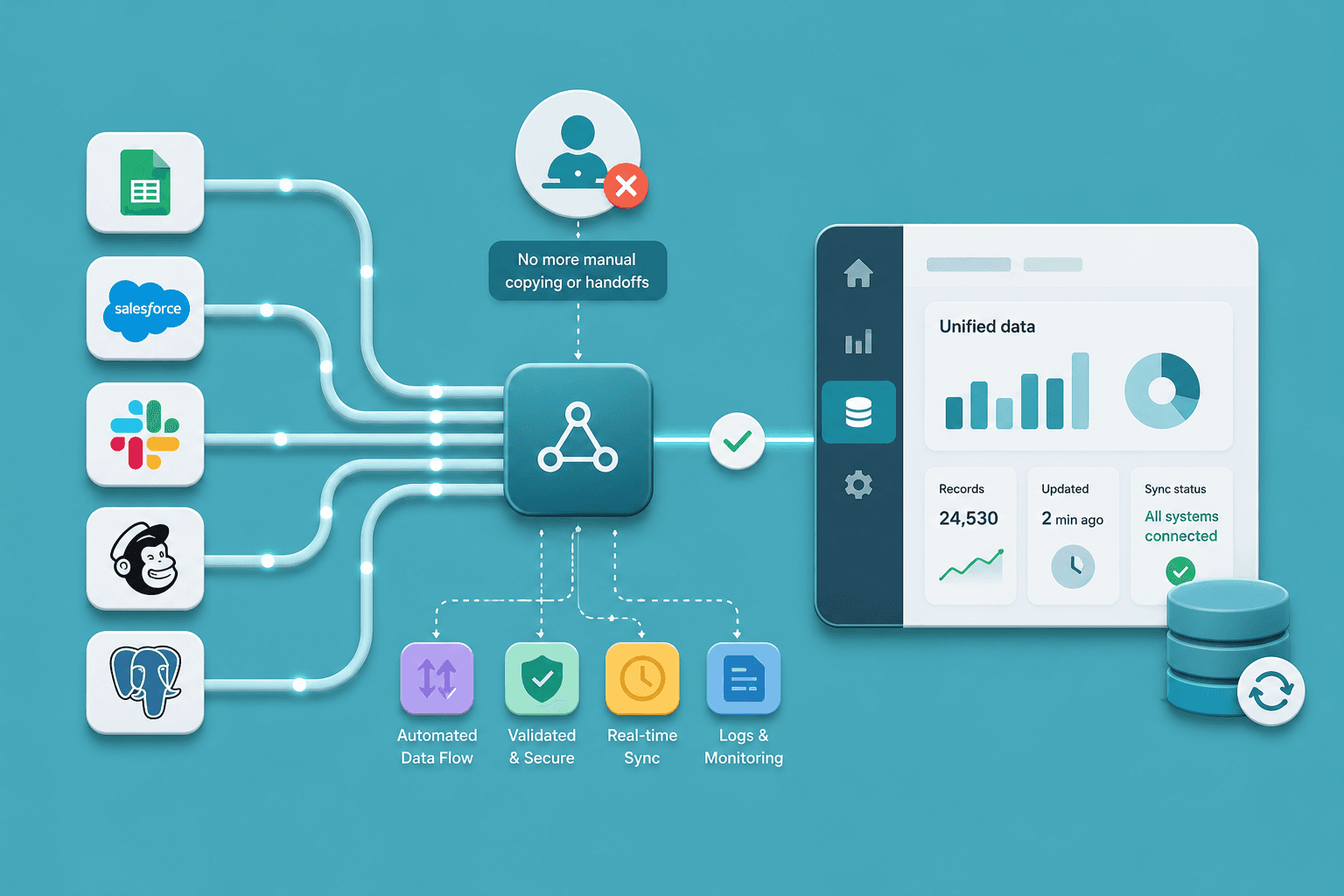
Where this service helps
Moving data is the easy demo. Real integration work defines identity, ownership, order, duplication, limits, and recovery.
One system has the latest status while another triggers the action.
Duplicate events create repeated messages or work.
Exports hide errors until reporting time.
Staff need broad permissions to perform narrow tasks.
A critical vendor has limits the workflow ignores.
Who this is for
Teams maintaining an existing website or application, connecting business tools, or extending an agency's delivery capacity.
Repair an unreliable connection
Identify field ownership, vendor changes, duplicate events, and error recovery.
Improve an existing product
Review code and infrastructure before prioritizing fixes or phased modernization.
Support a delivery partnership
Agree technical responsibilities, communication, access, and handover for a bounded engagement.
Service capabilities
01
API and webhook integrations
Event-driven exchange with validation, authentication, limits, and useful error records.
02
Scheduled synchronization
Controlled recurring jobs for systems without real-time events.
03
Data normalization
Map inconsistent fields, identities, statuses, dates, and formats.
04
Migration utilities
Move approved data with reconciliation, rollback planning, and completeness evidence.
05
Operational data layers
Place one structured service between source tools and dependent interfaces.
06
Reporting pipelines
Assemble source data into validated, repeatable reporting inputs.
What you receive
A defined delivery package, not an open-ended promise.
We agree the exact deliverables, acceptance criteria, and responsibilities in your proposal. A typical scope includes:
- 01Technical review and prioritized scope
- 02Implemented fixes, connections, or upgrades
- 03Release and regression checks for affected journeys
- 04Dependency, access, and account-ownership notes
- 05Operational documentation and support boundaries
How we deliver
- 01
Assess the system
Review access, repositories, dependencies, incidents, and operational requirements.
- 02
Agree priorities
Define scope, acceptance criteria, communication, and release responsibilities.
- 03
Implement safely
Make reviewable changes and test affected data flows and user journeys.
- 04
Document and support
Confirm operating instructions, escalation, and any ongoing care arrangement.
Tools and integration considerations
The technical approach follows your requirements, access, and operating model. Relevant components can include:
- APIs and webhooks
- Repositories and CI/CD
- Hosting environments
- Monitoring tools
- Vendor documentation
Build boundary
Agree the right foundation, project responsibilities, and operating requirements before implementation.
Source
Which system tells the truth for each field and state?
Identity
What makes an event unique, and what happens when it repeats?
Failure
What happens late, out of order, unavailable, or unauthorized?
Recovery
Who owns the credential, replay, correction, and reconciliation?
Planning your project
Start with an audit or discovery where needed, agree an implementation scope, and add ongoing improvements or care when useful. Pricing and timing reflect the agreed work; third-party charges are identified separately.
What shapes the estimate
- Existing code and infrastructure condition
- Vendor access and integration restrictions
- Support scope, release risk, and response expectations
Which tools can you connect?
We assess systems with supported APIs, webhooks, exports, or other agreed interfaces. The specific connection depends on vendor access, permissions, data structure, rate limits, and commercial terms.
What happens if an integration fails?
The scope defines validation, duplicate handling, logging, alerts, retries where appropriate, and manual recovery. Each connected field needs an agreed source of truth.
Can you work with our business outside the UK or Bangladesh?
Yes. We offer remote delivery worldwide, including North and South America, Europe, Asia, Africa, and Oceania. We agree meeting overlap, communication channels, and milestones around the project.
What should we prepare before requesting a proposal?
Share your business goal, intended users, current situation, required integrations, and timing. Budget context helps identify a practical first scope. A detailed technical specification is not required to start.
How are scope, handover, and ongoing support agreed?
The proposal identifies deliverables, assumptions, approval responsibilities, account and source ownership, and any ongoing costs. Support hours, maintenance, and future improvements are scoped explicitly.
Connected capabilities
Worldwide service delivery
Based in the UK and Bangladesh.
Working with businesses worldwide.
We provide website, software, SEO, and AI automation services across North America, South America, Europe, Asia, Africa, and Oceania. Remote collaboration is planned around your team and project.
- North America
- South America
- Europe
- Asia
- Africa
- Oceania
Let's build your next step